Better-informed market research uses trade data alongside customer, company, regulatory, and operational evidence, while keeping each source’s role clear. Trade flows can show recorded cross-border activity; they cannot independently explain customer motivation, future demand, or whether a particular supplier is suitable.
Key takeaways
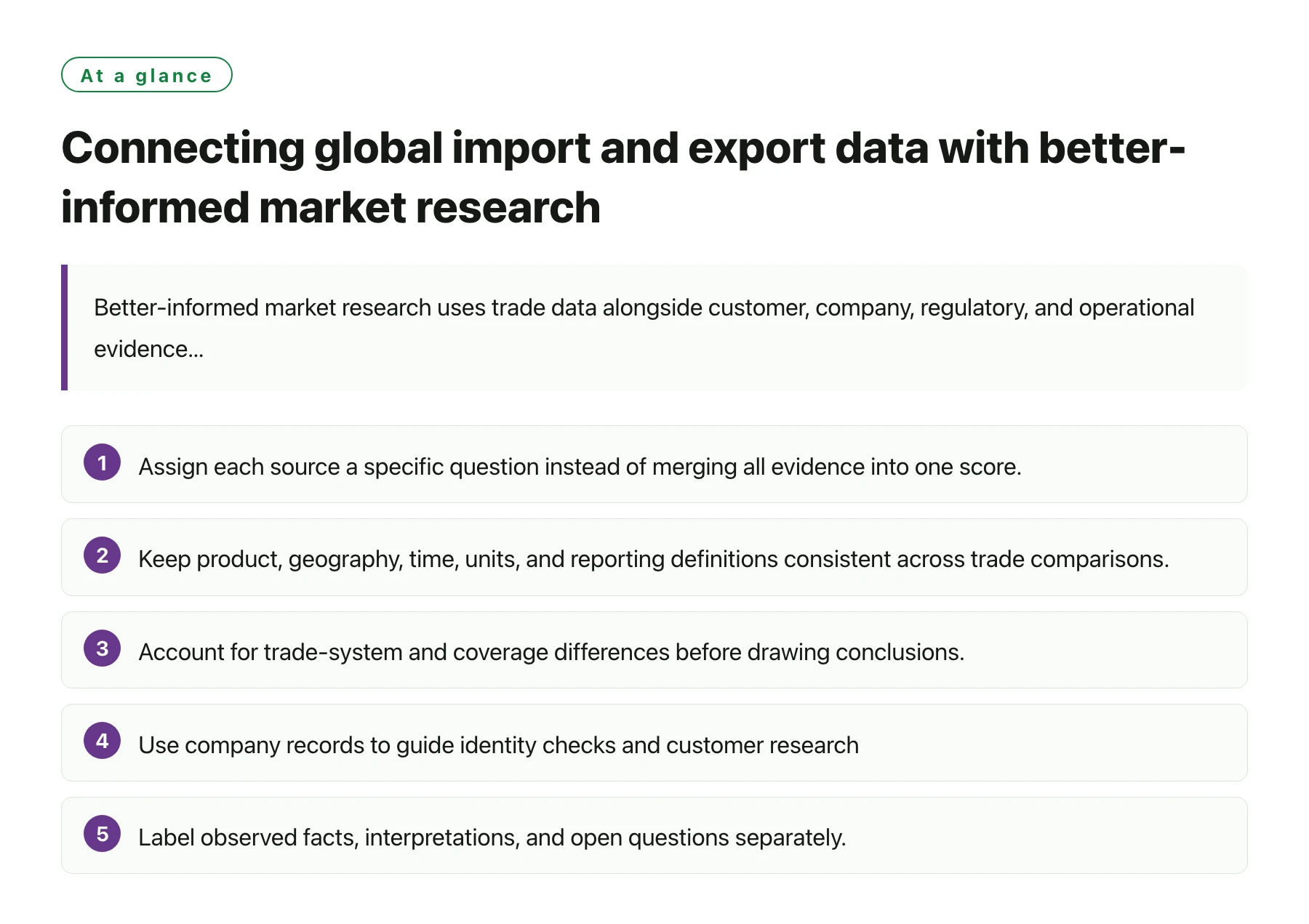
- Assign each source a specific question instead of merging all evidence into one score.
- Keep product, geography, time, units, and reporting definitions consistent across trade comparisons.
- Account for trade-system and coverage differences before drawing conclusions. [1]
- Use company records to guide identity checks and customer research, not replace them.
- Label observed facts, interpretations, and open questions separately.
International market research rarely depends on one dataset. Trade statistics can help show where goods are recorded as moving, while customer interviews can explain buying criteria and company research can clarify who participates in the market. The sources become more useful when each answers a different part of the problem.
The challenge is that data from different systems often uses different definitions. A company profile, a customs record, a product code, and a customer interview are not rows in one common table. A research design should connect their findings without pretending they measure the same thing.
1. Start with a question map
Break the business decision into smaller questions. A market-entry study might ask where the product appears in recorded trade, who purchases it, what standards apply, how it reaches customers, and how competitors position their offers. Trade data is most directly relevant to the first question and may help identify leads for the second. It cannot answer all five.
Create a question map with three fields: the question, the evidence source, and the decision it informs. This prevents the team from expecting a trade database to answer a regulatory question or using a customer interview as a substitute for a consistent import series.
Also define the boundaries: product, geography, period, and target segment. If the research question changes mid-project, update the map so that the evidence is not presented as though it was collected for the original scope.
2. Use trade flows to identify patterns worth testing
Choose a consistent product definition and examine relevant import or export series across multiple periods. Look for persistence, changes in partner mix, and areas where the data suggests a question for deeper investigation. Avoid turning the first visible pattern into a market conclusion; it is a hypothesis to test with other evidence.
Before comparing countries, review coverage, valuation, reporting systems, classification revisions, and missing observations. General and special trade systems can treat warehouse and re-export flows differently. The WTO’s technical notes describe these methodological differences and explain why definitions matter for international comparisons. [1]
Keep the source and retrieval date attached to every result. A later revision may change the historical series, and a chart without its product code or unit can be difficult to interpret. State whether the observation is an aggregate statistic, a company record, or a shipment-level record.
3. Add customer evidence to interpret the signal
Once a trade pattern identifies a market for follow-up, customer research can test the reasons behind it. Interviews, surveys, sales conversations, and distributor discussions may reveal which product features matter, how procurement works, and what problems current suppliers do or do not solve.
Use a consistent interview guide across comparable customer segments. Ask about purchasing criteria, current alternatives, timing, required certifications, and decision roles. Record the sample and limitations: a few conversations can surface themes but may not represent the entire market.
If trade data and customer interviews point in different directions, keep both findings visible. A strong recorded flow with weak customer interest may reflect a product mix or channel structure that needs explanation. Positive interviews with little recorded trade may suggest a niche, a classification issue, or a new category that is not yet visible in the selected series.
4. Use company records as a discovery layer
Company and shipment records can help identify organizations to research after a market screen. They may surface names, product descriptions, trading relationships, or route patterns that are useful for follow-up. The analyst still needs to determine whether the record belongs to the correct legal entity and whether it is relevant to the current product and period.
Confirm the company through independent information such as its official site, filings, business registry, or direct contact. Check for subsidiaries, alternate spellings, distributors, and intermediaries. Do not infer purchasing intent from a record alone. A record is a point in a source system, not a conversation with the buyer.
If a team needs searchable TradeData.Pro records for company research, evaluate sample results against a named task. Compare coverage, geography, period, available fields, and the clarity of entity resolution. Keep platform results identified separately from official statistics and customer evidence.
5. Bring in regulation and operations before making a recommendation
Trade activity does not establish that a product can be sold in a market under the company’s planned model. Review tariffs, standards, labeling, licenses, sanctions, data restrictions, and other market-specific requirements with appropriate authoritative sources. The exact checks depend on product and jurisdiction.
Logistics research should test routes, transit time, reliability, handling needs, insurance, and landed cost. Shipment patterns can suggest which routes appear in a dataset, but a historical route does not guarantee availability, current service quality, or a suitable cost for a new shipment.
For the United States, the Census Bureau’s trade resources provide statistics by classification and geography; tariff treatment and regulatory obligations require separate sources. This illustrates why a single trade dataset should not be used as a proxy for every commercial or policy question. [2]
6. Keep the evidence layers distinct
| Evidence layer | Question it helps answer | Example limitation |
|---|---|---|
| Trade statistics | Where and when are flows recorded? | Definitions, coverage, valuation, or revisions differ. |
| Customer research | What needs and buying criteria matter? | Small or non-representative samples. |
| Company research | Which organizations should be checked? | Entity matches and current activity need verification. |
| Regulatory review | What rules apply to this product and market? | Requirements vary by product and jurisdiction. |
| Logistics and cost | Can the offer reach the market competitively? | Historic routes do not establish current service or price. |
Link the layers in the recommendation, but do not erase their different methods or limitations.
7. Write a synthesis that can be challenged
A synthesis should state what each source contributed and where sources align or conflict. Separate direct observations from interpretations. For example, a trade series may show reported activity, interviews may describe unmet needs, and a regulatory review may reveal a barrier. Each finding has a different level of certainty and should be labeled accordingly.
Identify the most important unresolved question and the next evidence that would address it. This could be a larger customer sample, legal review, company verification, or a refreshed data pull. A decision-maker can then see what is known, what remains uncertain, and what action is proportionate to the current evidence.
Better-informed market research does not mean collecting the maximum amount of data. It means using the right evidence for the question, checking how that evidence was produced, and resisting conclusions that reach beyond the available support.
Sources
Frequently asked questions
What role should trade data play in market research?
It can help identify recorded flows and patterns that merit follow-up, while customer, company, regulatory, and operational sources address different questions.
Should different evidence sources be combined into one score?
Only with a transparent method. In many projects it is clearer to show the sources separately and explain where they support or conflict with one another.
Can company shipment records confirm buyer intent?
No. They may guide discovery but do not establish current purchasing plans or commercial fit.
What should researchers do when trade data and interviews disagree?
Keep both findings visible, check their scope and sample, and identify what additional evidence could explain the difference.